The local assignment of Mongolian Prime Minister L. Oyun-Erden continues in Arkhangai province. On this occasion, he got acquainted with the construction process of the newly built 300-bed general hospital in the province.

A comprehensive building that meets the requirements of modern medical standards, consisting of eight blocks, including an ambulatory, an inpatient unit, an oxygen and diesel station building, is being built at a cost of 25.2 billion MNT. Currently, the construction is 85 percent complete.

The main building of the Provincial General Hospital, which is currently operating, was commissioned in 1979. With a capacity of 160 beds, it currently provides referral level health care services with more than 200 beds. In the future, the provincial authorities developed a project to turn the old general hospital building into a “nursing training, research, health care and service complex” under the ASUU. He said that 19.2 billion MNT is needed for this. He also said that there is a shortage of nurses and special specialists in the province.

Governor of the province B. Tserennadmid presented the planning, engineering infrastructure, road improvement solutions and problems of the new settlement zone Bulgankhangai. Arkhangai province has established a new residential area on a total area of 60 hectares, and is working to build and improve Bulgankhangai-1 and 2 neighborhoods. Currently, 1,500 housing units have been allocated in eight locations. It is estimated that more than 113,000 people from 2,830 families will live in the settlement area, and the supply of housing will increase by 45 percent. At present, more than 80% of the province is in residential areas.

The 300-bed general hospital building is one of the first developments in the new residential area, and the Bulgankhangai-2 neighborhood will be put into operation in November this year. In the first 20 hectares of the neighborhood, there are 120 family apartments, 150 kindergartens, swimming pools, 320 children’s schools, sports halls, boarding houses, Emergency Department, Teacher Development Center, Prosecutor’s Office, Musical Drama Theater, “MCS” LLC. 63.2 billion was invested in commercial warehouse buildings, engineering networks, and infrastructure.

He said a total of 18.5 billion MNT is needed for the infrastructure and beautification of Bulgankhangai district, such as roads, bicycle and footpaths, lighting, green facilities, clean water facilities, electricity and heat supply. One of the problems in the province is heat supply. The thermal power plant is privatized, 11 boilers are solely managed by one company. There is not enough capacity to provide heat to newly commissioned enterprises and households with private residences. Therefore, I asked the Prime Minister to pay special attention to the issue of heat supply.

During his visit to Darkhan-Uul province, Prime Minister L. Oyun-Erdene inspected the operations of the Darkhan Metallurgical Plant. Established in 1990 using iron ore deposits from the Darkhan-Seleng region, the plant saw the economic activation of the Tumurtolgoi iron ore deposit in 2010, leading to the establishment of an open-pit mine.

In 2014, QSC LLC entered into a concession agreement with the Ministry of Economy and Development for a mining and metallurgical complex project. However, on April 13, 2022, the government, through Resolution 148, canceled the agreement due to the company’s failure to meet its obligations.

The Darkhan Metallurgical Plant annually produces 100,000 tons of steel products and 2.5 million tons of iron ore concentrate, supplying both domestic and international markets.

However, during the implementation of the concession agreement for the mining and metallurgical complex construction, the production process faced disruptions. This was due to the concessionaires’ failure to maintain the plant’s technology and machinery, as well as discontinuing the procurement of spare parts and inventory.

Following a government decision, the plant was returned to state ownership and underwent management reforms. G. Dugarjav, the executive director of the Darkhan Metallurgical Plant, reported a loss of 9.6 billion MNT in April 2022 but achieved a net profit of 17.3 billion MNT in 2023. In the same year, the plant contributed 15.2 billion MNT to the state budget and 13 billion MNT to the Darkhan-Uul Province budget.

Prime Minister L. Oyun-Erdene has directed the Minister of Finance to address the damages incurred by the plant due to QSC. He underscored the significance of the Darkhan Metallurgical Plant becoming the cornerstone of steel production in the nation. Additionally, he has instructed relevant officials to enhance the plant’s capacity to meet domestic market demands.

There is a plan to construct a steel processing complex centered around the Darkhan Metallurgical Plant in three phases, with the goal of having it operational by 2027. Based on an analysis of the demand and supply of steel products, Mongolia’s annual demand in 2023 stands at approximately 500-600 thousand tons, with projections indicating that this figure will surpass one million tons by 2027.

Nationally, development centers for people with disabilities are under construction in 21 provinces and 9 districts, with financial support from the Asian Development Bank. The centers in Khovd and Dundgovi provinces are already operational. Furthermore, on September 14th, the Development Center for People with Disabilities in Darkhan-Uul Province was officially inaugurated, with Prime Minister L. Oyun-Erdene present at the opening ceremony, where he delivered a speech.

The Prime Minister emphasized, “Vision 2050, Mongolia’s long-term development policy, is committed to creating a comprehensive, multifaceted development system that fully supports individuals with disabilities and guarantees their equal participation in society. As part of this overarching vision, we are establishing a Center for the Development of People with Disabilities in every province and district. Our focus is not just on providing physical infrastructure; it’s about delivering essential care services and, more importantly, safeguarding the voices and rights of individuals with disabilities within our society. We must work towards changing societal attitudes towards disabilities.”

Mongolia is home to more than 115,000 individuals with disabilities, with approximately 67 percent of them residing in rural areas. This includes around 5,200 people in Darkhan-Uul province. The Center for the Development of People with Disabilities is set to offer a range of crucial services, including rehabilitation, early diagnosis, and developmental support for both disabled children and adults. The center will also organize counseling and training programs for family members and guardians. Additionally, it will provide psychological and psychotherapeutic services, along with guidance on the procurement and utilization of prosthetics, orthopedics, and other tools, including their adjustment and repair.

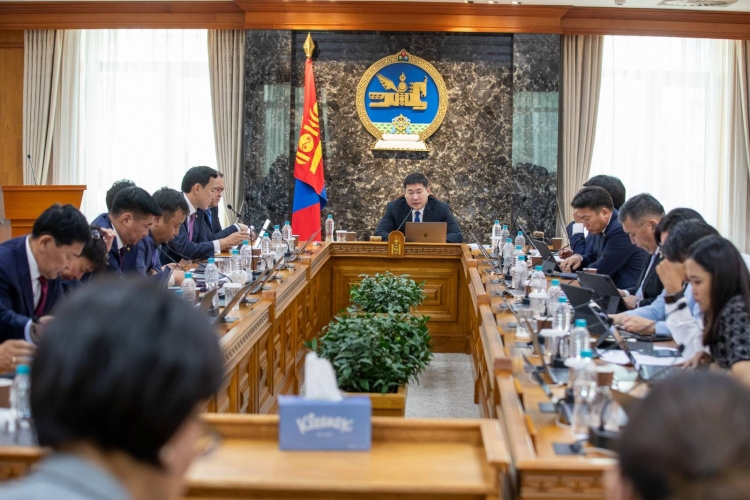
The Cabinet convened its regular meeting on September 13, 2023, during which several matters were deliberated upon and subsequently addressed.

The Prime Minister has ordered the commencement of EPC-4, a package of the oil refinery project, with the aim of fully operationalizing the plant by 2027.

The Mongolian Government is committed to accelerating the progress of the oil refinery project. During the Cabinet meeting, the Prime Minister issued directives to compensate for the 13 months of lost work due to the COVID-19 pandemic. Specifically, the Prime Minister ordered the commencement of construction for the EPC-04 package of the Oil Refinery and emphasized the need to intensify efforts to ensure the plant becomes operational by 2027.

Mongolia aims to meet 100% of its domestic wheat and potato requirements, as well as produce over 80% of its vegetables locally.

During the Cabinet meeting, Minister of Food, Agriculture, and Light Industry Kh. Bolorchuluun presented the initial harvest results. It is estimated that Mongolia will yield 480 thousand tons of wheat, 165 thousand tons of potatoes, 165.8 thousand tons of vegetables, 64.8 thousand tons of oilseeds, 225.6 thousand tons of fodder plants, and 5 thousand tons of fruits. These results mean that Mongolia can now satisfy 100 percent of its wheat and potato demands, along with 81.3 percent of its vegetable requirements, all sourced from domestic crops.

Anticipated increases in production include a 19 percent rise in wheat, amounting to an additional 79 thousand tons, an 18.3 percent boost in vegetable production, equivalent to 25.7 thousand tons, a substantial 42.4 percent growth in animal feed production, contributing 67.2 thousand tons, and a 25 percent uptick in fruits and vegetables, totaling 1 thousand tons.

The agreement on air transport between the Government of Mongolia and the Government of the United States of America has been approved.

In light of the government’s declaration of Visit Mongolia Year for 2023-2025, the Ministry of Road and Transport Development has set ambitious objectives to enhance air travel. Their plan involves rapidly expanding flight routes and frequencies within a short timeframe, with intentions to secure air traffic agreements with approximately 10 new countries in 2023-2024.

In line with this strategy, efforts to establish an air communication agreement with the United States of America have been intensified. The draft agreement was deliberated upon during the Cabinet meeting on December 7, 2022. Subsequently, on August 4, 2023, during the official visit of the Prime Minister of Mongolia to the United States, the agreement was officially signed.

The “Agreement between the Government of Mongolia and the Government of the United States of America on Air Transport” now paves the way for direct flights between the two nations. This development will enable Mongolian citizens to travel comfortably to the United States at competitive rates. Furthermore, it is expected to boost the competitiveness of national air carriers and lead to the expansion and development of the air communication and flight network.

Mongolia is set to enhance its digital transition through collaboration with relevant institutions in Estonia.

During the cabinet meeting, Minister of Digital Development and Communications, N. Uchral, delivered a comprehensive overview of Mongolia’s participation in the eighth “Open Government Partnership” international conference, which took place in Tallinn, the capital of the Republic of Estonia.

In light of this, the Ministry of Digital Development and Communications has been entrusted with the responsibility of accelerating Mongolia’s digital transition through collaboration with relevant Estonian institutions. Furthermore, the minister has been given directives to initiate necessary measures aimed at creating a conducive environment for foreign investors, entrepreneurs, and high-tech experts to conduct business in Mongolia.